Landscape Lighting
Landscape Lighting Design: What to Light and What to Leave Dark
Roper Lawn Care • October 2026 • Memphis, TN • 7 min read
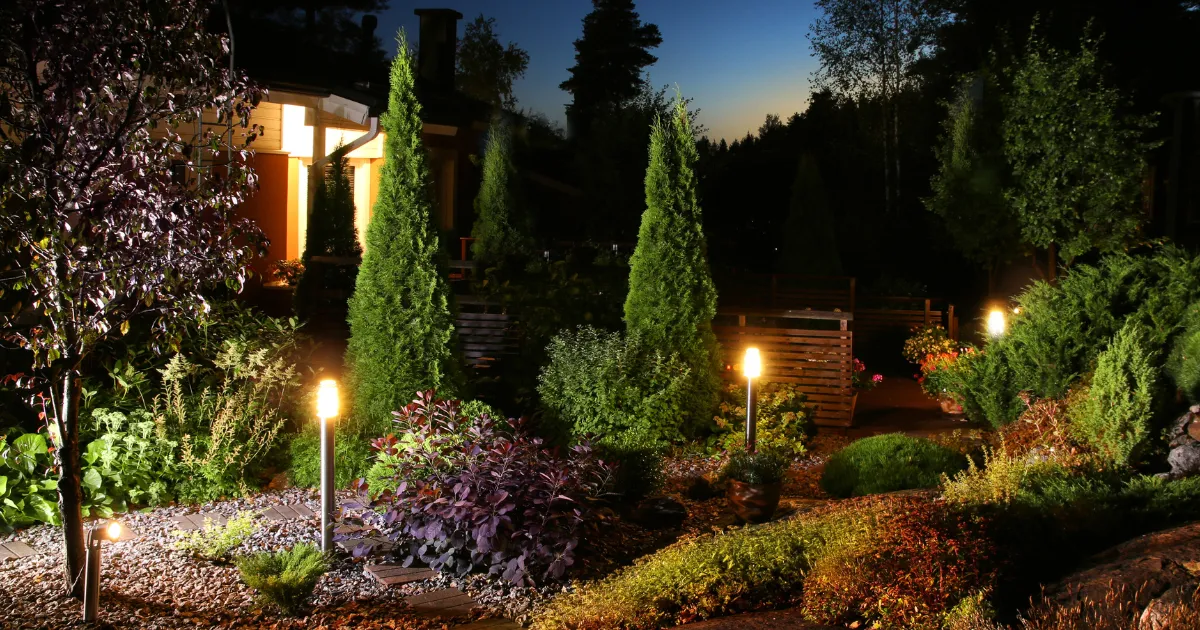
Short Answer: Good landscape lighting is defined more by what stays dark than by what gets lit. The approach that works is choosing a small number of features genuinely worth seeing after dark, lighting those deliberately, and leaving everything else in shadow so the lit elements read. The common failure is the opposite, meaning evenly spaced path lights marching down a walk with nothing else lit, which produces a runway rather than a landscape.
Every October we start getting calls about landscape lighting, and the timing is not coincidental. Daylight contracts quickly through the month, the clocks fall back on the first of November, and suddenly the yard people spent money on is invisible during every hour they are home to see it.
Before anyone starts placing fixtures, it is worth thinking about the design. Here is how we approach it and what separates lighting that looks intentional from lighting that looks installed.
Darkness Is Part of the Design
This is the idea that changes everything, and it runs against intuition.
The eye reads contrast. A lit tree looks dramatic because the space around it is dark. Light everything evenly and nothing stands out, which produces a yard that is visible and flat.
So the first step is not deciding where fixtures go. It is choosing what deserves to be seen after dark, and on most properties that is a short list. Three to six elements is plenty.
A specimen tree with good structure. The front entry. An architectural feature of the house. A water feature. The patio where people actually sit. Everything else can stay dark and generally should.
We have found that homeowners who light the three best things on a property are consistently happier than those who light twelve things adequately.
The Techniques Worth Knowing
A handful of approaches cover nearly everything, and knowing the names makes the design conversation much easier.
Uplighting places a fixture at ground level aimed up into a tree or a wall. On trees it reveals branch structure and creates the most dramatic effect available in a landscape. Around Memphis that means the mature oaks and the crape myrtles with their peeling trunks, both of which take light beautifully.
Downlighting, sometimes called moonlighting, mounts fixtures high in a tree aimed down through the canopy. The result is dappled light on the ground that reads as moonlight through leaves. It lights usable space rather than just objects, which makes it excellent over a patio.
Grazing sets a light close to a textured surface and aims along the face, throwing the texture into relief. On the brick and stone common across Memphis housing this is genuinely striking and costs very little to add.
Silhouetting lights a surface behind an object so the object reads as a dark shape against a glow, which suits a plant with a strong outline where form matters more than detail.
Path lighting illuminates walking surfaces for safety, and it is the technique most often overused.
The Path Light Problem
Nearly every disappointing installation we are asked to look at has the same issue, and it is worth describing precisely.
Path lights get placed evenly on both sides of a walk, spaced every six or eight feet, each throwing an identical circle on the pavement. The result looks like a runway. It is symmetrical, repetitive, and it draws attention to the fixtures rather than to the landscape.
The better approach uses fewer lights, staggered rather than paired, spaced far enough apart that the pools do not connect into a continuous strip. Ten to twelve feet apart, alternating sides, reads as guidance rather than as a runway. The gaps are not a failure, they are what makes it look deliberate.
Path lights also work far better when they are not the only thing lit. The same walk with a few staggered lights and an uplit tree alongside reads completely differently, because the tree gives the eye somewhere to go.
Fixture height and shielding matter too. A path light should throw light down onto the surface, not out at eye level. If you can see the bulb walking toward it, the aiming or the shielding is wrong and you are getting glare rather than illumination.
Color Temperature
One technical decision with outsized effect on how the result feels.
Color temperature, measured in Kelvin, determines whether light reads warm or cold. Around 2700K is warm and inviting, and it flatters plant material along with the brick and stone that dominate Memphis housing. Push up toward 4000K or 5000K and the effect turns blue and clinical, closer to a parking lot than a garden.
Consistency matters as much as the number. Mixing color temperatures across a property is visually jarring even to people who cannot name what is bothering them, and it is the most common complaint about inexpensive lighting kits where fixtures were bought at different times.
If the house already has any exterior lighting, matching the landscape fixtures to it keeps the whole elevation reading as one design.
Designing for How the Yard Is Used
The design should follow behavior, and that is a conversation rather than a template.
Where do people walk? That route needs enough light for safe footing, particularly at steps and grade changes. Step lights handle those better than trying to light a step from a distance.
Where do people sit? That area wants ambient light rather than focused beams. Downlighting from a tree or soft fixtures at the perimeter serve it better than a bright fixture pointed at the seating.
What do you look at from inside? This gets forgotten constantly, and through a Memphis winter most of your viewing happens through a window. A lit tree visible from the kitchen delivers more value than a fixture in a corner nobody looks at.
And what should stay hidden? The utility area, the trash enclosure, the equipment. Leaving those dark is a decision worth making on purpose.
Glare Undermines Everything
Glare is what happens when you see the light source instead of the lit object, and it defeats an installation faster than almost anything else.
The fix is mostly aiming and shielding. Fixtures should sit so the source is hidden from the angles people actually view from, meaning the patio, the main windows, and the walk up to the front door. Glare guards, hoods, and simply tucking a fixture behind a plant all work.
This is why uplights aimed at trees should sit close to the trunk and angle tightly rather than sitting far back and throwing wide. A tight beam catches the tree. A wide one catches the tree, a neighbor's window, and the eyes of anyone coming up the drive.
Being a good neighbor factors in. Light spilling across a property line is a genuine annoyance and it is entirely avoidable with aiming.
Why It Matters More Right Now
The seasonal argument is straightforward and it is why the calls start in October.
Sunset moves quickly through the month, and after the clock change on the first of November, darkness arrives before most households have finished the workday. From then through February, the landscape is invisible during essentially every hour anyone is home.
That is a third of the year during which anything planted, built, or maintained outside simply does not exist visually.
It also changes how the inside feels. A lit exterior visible through windows makes a room feel less bounded by black glass, which sounds minor and is noticeable across a winter.
What to Do Next
Walk the property after dark this week with a good flashlight and try lighting things temporarily. Shine it up into a tree from a few positions and see what the structure does. Graze it along a brick wall. Stand where you normally sit and look at what you would want to see.
Make a short list of the three to six elements genuinely worth lighting, then resist adding to it. That list is a better design brief than a fixture count.
Look at the property from inside too, from the windows you actually use in the evening, since that perspective changes priorities more often than people expect.
If you have existing path lights marching evenly down a walk, consider removing half of them and staggering the rest before buying anything new.
To discuss a design for your property, call Roper Lawn Care at 901-290-8165 or visit roperlawncarememphis.com. We serve Memphis and the surrounding communities.